How to Build Great Leaders
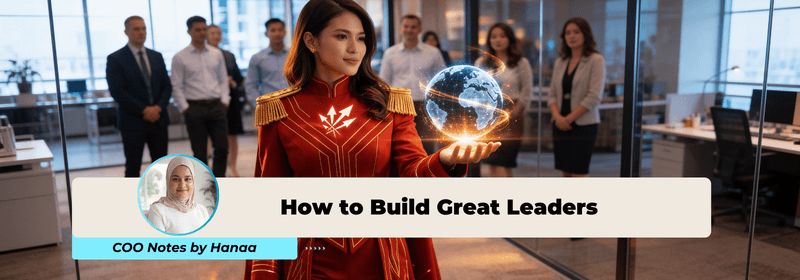
Why future-proofing talent starts with who your people become, not what they learn
Last week, I gave a talk at INTI to students and lecturers. It reminded me how early leadership habits form, and how quickly they start shaping someone’s career.
I wasn’t there to hype anyone up. I wanted them to leave with something solid: a clearer picture of what “great leadership” looks like when the world is moving fast, and when AI is changing how people prepare, communicate, and perform.
Here’s the pattern I keep seeing, in universities and in organisations.
On paper, many people look ready.
Then the pressure shows up.
A tough conversation. A messy project. A big change.
And suddenly, you see who can actually lead.
For HR leaders building talent strategy, that gap matters. Because you’re not just building skills. You’re building the next layer of leaders your organisation will rely on when things get uncertain.
If you want stronger leaders, the answer isn’t more inspiration. It’s a system that builds capability that holds up under pressure and shows up in real work.
In my talk, I used a framework called CARES to break this down. It’s simple enough to remember, but strong enough to build a talent system around.
The CARES framework: future-proofing human capability
I shared CARES as a simple way to explain what “great talent” actually looks like when you zoom out beyond grades, titles, or confidence.
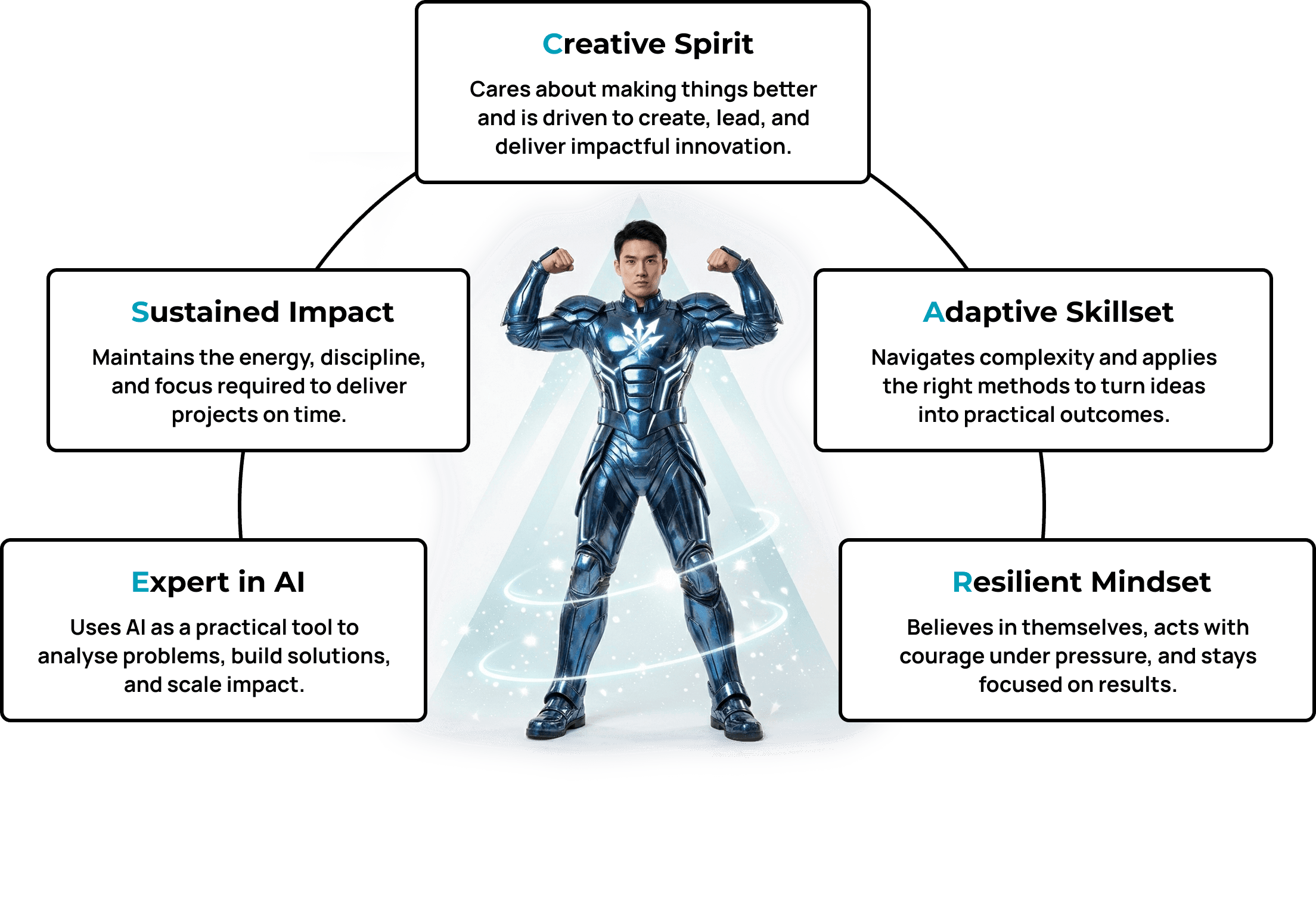
Creative Spirit
Creative spirit means the person cares. They want to make things better, improve systems, and contribute beyond what’s required.
For HR, this shows up as: people who take initiative without being chased. They spot gaps early. They suggest fixes. They don’t wait for a perfect brief.
Adaptive Skill Set
Adaptability is built through core skills: leadership, management, collaboration, communication, and entrepreneurship (initiative and ownership).
For HR, this shows up as: development that forces real range. Cross-team work. Ambiguity. Delivery. If your system rewards “staying in lane,” you’ll get narrow performers, not adaptable leaders.
Resilient Mindset
Resilience is staying brave, bold, and brilliant even when things are hard. Rejection. Failure. Awkward moments. Self-doubt.
If your culture punishes mistakes, people start protecting themselves instead of learning and connecting. Psychological safety becomes a performance tool, not a “nice extra.”
Expert in AI
This is where I see a lot of organisations get the tone wrong.
AI gives people an advantage when they use it for preparation. In the talk, I shared practical uses: learning faster, creating stronger presentations, generating ideas, improving productivity, and communicating more clearly.
And this is the link to influence that people miss:
When you are prepared, you speak better. When you speak better, people listen.
Sustained Impact
Great leaders don’t burn out. They build stamina to deliver consistently.
Sustained impact comes from good health: mental, physical, emotional. If health collapses, influence collapses.
If your organisation keeps celebrating “high performers” while ignoring energy debt, you will lose your best people, or keep them but dull them over time.
What this means for HR leaders building talent strategy
One thing I’ve learned is this: HR doesn’t need more theory. HR needs proof that the capability is moving.
With our client AMK (microfinance banking), a post-program survey was run using the CARES standard, and participants rated the overall programme value 4/5.
The participants shared that they now have stronger confidence to test ideas, and they were able to apply AI inside real workflows successfully.
If you want future-proof talent, don’t start by asking, “What training should we run this quarter?”
Start by asking: Are we building great leaders?
CARES is a system HR can build into hiring, development, performance, and culture.
A simple HR design checklist you can use immediately
Do we reward “making things better” or only “doing what’s assigned”? (Creative Spirit)
Do our talent programs build real cross-functional capability or just teach concepts? (Adaptive Skill Set)
Do people feel safe enough to try, fail, and still be respected? (Resilient Mindset)
Do we use AI as a workflow habit that improves productivity? (Expert in AI)
Do we protect energy, health, and sustainability as a leadership asset? (Sustained Impact)
If you’re serious about future-proofing talent, CARES gives you a practical lens for hiring, development, and culture. And if you want help embedding it through real projects, that’s what we do at Leadapreneur. We help HR build this capability through an AI Talent Accelerator. Each participant works on a real business problem and uses AI to strengthen the workflow around it, inside your organisation.