The Great Acceleration: A Strategic Briefing for CEOs in the Age of AI
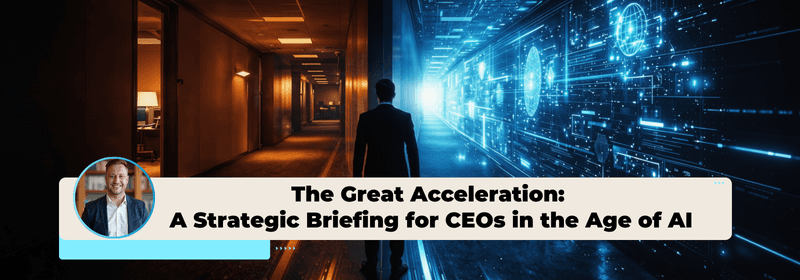
By Jan Henrik Bartscht, Founder & CEO of Leadapreneur
The Next 5 Years Will Change As Fast As the Last 25 Years.
Imagine accelerating from the year 2000 to the year 2025 in just 5 years. That's a LOT of change in a little time. I believe that's what the next 5 years will look and feel like.
As new technological capabilities come online, and new political realities emerge, entirely new challenges are emerging much much faster and with much much greater impact than ever experienced by leaders before. What do we do?
I think it's important to recognise that this challenge will be different for everyone. Yet we will be unified by the experience that a Great Acceleration is taking place, the sense that change itself has changed and that everything really is happening much much faster and with much much greater technological impact than ever before.
We are entering a period where the next five years will compress what previously took twenty-five. The pace of change in the age of AI is no longer linear, it is accelerating. At a minimum it's doubling every year but in some places AIs impact is growing 10x or even higher. Across industries, capabilities that once took decades to mature are now emerging within a single business cycle. Entire categories of work are being redefined, competitive advantages are dissolving faster than they can be defended, and organizations are being asked to adapt at a speed most management systems were never designed to handle.
I describe this moment as the Great Acceleration. Three powerful forces are driving it.
The 3 Forces Driving the Great Acceleration
1. Unprecedented AI Infrastructure Investment
The first is the unprecedented scale of AI infrastructure investment. Technology companies are now committing hundreds of billions of dollars annually to advanced compute, data centers, and specialized chips. AI is rapidly becoming a foundational layer of the global economy, much like electricity in the industrial age. When infrastructure of this magnitude comes online, entire sectors transform around it.
2. The Democratization of Capability
The second force is the democratization of capability. Hundreds of millions of people now have access to AI tools that dramatically expand their ability to analyze information, generate solutions, and execute work. Innovation is no longer limited to specialized technical teams. It is emerging everywhere inside companies, across industries, and across geographies.
3. Strategic Competition
The third force is strategic competition. Nations and cities around the world are racing to position themselves as centers of AI capability. Governments are investing heavily in research, infrastructure, and talent pipelines, recognizing that leadership in AI will shape economic power in the decades ahead.
What Has Actually Changed: The End of Disruption Waves
Taken together, these forces are reshaping the environment in which organizations operate. In the past, disruption tended to arrive in waves. Companies had time to stabilize, adapt, and rebuild before the next shift occurred. Today that rhythm has disappeared. The environment does not pause between transformations. It moves forward continuously, compounding innovation, competition, and expectation.
The Real Constraint Is Not Technology — It's Talent
At the center of this challenge lies a simple but critical reality: AI does not create value on its own.
Technology alone provides only potential. Value is generated by people who know how to apply that capability effectively. Organizations can invest heavily in AI platforms and still see limited impact if their workforce lacks the confidence, judgment, or cultural permission to use them meaningfully. The real constraint in AI transformation is therefore not technology, it is talent and the culture is operates in.
This is where many organizations are encountering some problems.
Do my people have the right mindset and skillsets to unlock the power of AI? Or are they just writing better emails?
Are we building useful projects with AI with measurable ROI? Or are we trapped in innovation theatre?
Does our culture really embrace change? Or is our
bureaucracy murdering innovation?
Why Traditional Training Cannot Keep Up
Most corporate learning systems were designed for a slower world. Training programs, workshops, and development initiatives typically operate on an annual cadence. They focus on transferring knowledge rather than building capability, and they take place outside the flow of real work.
In the Great Acceleration, this model simply cannot keep up.
Traditional training has no chance of catching up to the pace of AI-driven change. It was designed for a world where new capabilities emerged every few years not every few months. By the time a training program is designed, approved, delivered, and absorbed, the tools and practices it teaches may already have evolved.
More importantly, training assumes that people learn by being told what to do.
In the age of AI, that assumption breaks down.
What organizations need now is not more training, but more building.
People develop real capability by applying AI to real problems, experimenting with solutions, and learning through rapid cycles of execution and feedback. The shift required is therefore profound: from a culture of training to a culture of building.
This is where leadership becomes decisive.
Why AI Adoption Stalls: The Hidden Cultural Bottleneck
Accelerating AI adoption is not a matter of installing AI systems. Many organizations have already deployed sophisticated tools across their technology stack. Yet despite these investments, the expected gains in productivity and innovation often fail to materialize.
The reason is cultural.
AI adoption only accelerates when people actively build with it. Tools do not transform organizations by themselves. People must experiment with them, integrate them into their workflows, and use them to solve real problems. In other words, accelerating AI adoption means creating a culture where individuals feel both capable of and responsible for innovating with AI.
The Manager Problem
Managers play a crucial role in determining that culture.
They sit at the operational center of the organization. They shape how teams prioritize work, how problems are approached, and how change is interpreted. When managers encourage experimentation and initiative, innovation spreads quickly. When they default to traditional processes and risk avoidance, progress slows dramatically.
This is where many organizations encounter a hidden bottleneck.
Most managers were trained and promoted in a pre-AI world. Their professional identity is built around planning, coordination, and incremental improvement. Those skills remain valuable, but they are no longer sufficient. In the age of AI, managers must also experiment rapidly, regularly integrate new tools into everyday work, and translate technological capability into tangible outcomes.
Without that shift, managers unintentionally slow the very transformation their organizations are trying to achieve.
The challenge, therefore, is not simply to teach managers new tools.
It is to help them evolve their identity as leaders.
The Solution: The Rise of the Leadapreneur
To accelerate AI adoption, organizations need a new kind of manager: the leadapreneur; a leader who innovates with AI.
Rather than treating AI as a support tool, leadapreneurs use it as a force multiplier to redesign workflows, solve problems, and generate measurable value. They combine the accountability of leadership with the experimentation mindset typically associated with entrepreneurs.
This shift changes how AI spreads within the organization.
Instead of relying on centralized innovation teams, leadapreneurs identify opportunities within their own domains and build solutions rapidly. Teams begin using AI not only to automate tasks but to rethink how work is done, accelerate decisions, and unlock new sources of growth. Over time, this creates a distributed engine of innovation across the enterprise.
The Bottom Line for CEOs
In the Great Acceleration, organizations cannot afford slow transformation.
The companies that succeed will not simply be those with access to AI, but those that mobilize their people to build with it continuously and at scale.
The biggest bottleneck to the problem of AI adoption lies in talent and culture not technology. Specifically, how to upgrade traditional managers and leaders into talents who can reliably and repeatedly build with AI?
It's not a reskill problem, it's an identity problem. To innovate with AI, we need to holistically upgrade managers into leadapreneurs, leaders who innovate with AI. The fastest way to accelerate AI adoption is to upgrade 30% of your managers into leadapreneurs. That's how you solve the bottleneck. With enough people bringing a fresh mindset and a powerful new skillset, your organisation will be confidently surfing the Great Acceleration for the next 3 years.

Jan Henrik Bartscht is the Founder & CEO of Leadapreneur, helping organizations build AI-ready leadership at scale.