The Real Story in the 2028 Intelligence Crisis Report
There’s a piece floating around in parts of the AI and finance world that’s been getting a lot of attention. It’s from Citrini Research, and it’s written as a future memo from the year 2028. The scenario they paint is unsettling: AI capabilities have kept rising, companies have been cutting staff and buying more AI, and suddenly the economy starts behaving in ways no one expected. Markets slide, unemployment rises, and traditional economic measures stop making sense.
The piece feels almost like a fictional warning letter from the future. But people — especially in finance — started talking about it as if it were a prediction. Bloomberg even carried a story about markets reacting somewhat nervously after the report gained attention.
I don’t think the report is doom and gloom. I don’t think it’s a forecast that will definitely happen. But it raises a question that deserves deeper thought: What if the way we use AI changes the economy in unexpected ways, not over decades, but much faster?
Because that’s the part worth paying attention to.
What the Report Was Getting At
There were a few ideas in the Citrini scenario that really stood out to me.
One is the idea of rising productivity without rising household income. The report talks about something they call “ghost GDP,” where output is technically increasing, but the gains never flow back into people’s lives. In that world, GDP looks healthy even as wages and demand decline.
Another idea is that there can be feedback loops that don’t resolve themselves. The report describes a cycle where companies lay off workers to cut costs, then invest those savings in more AI, which makes them even more efficient. In doing so, they reduce the number of people earning wages who can then buy things. It’s not because any individual company is making a bad decision. Each company is acting rationally. But when more and more companies act the same way, the system as a whole can behave in ways that are more fragile than any one company anticipated.
Just have a look at what Jack Dorsey from Block did last week and what Meta did this week:
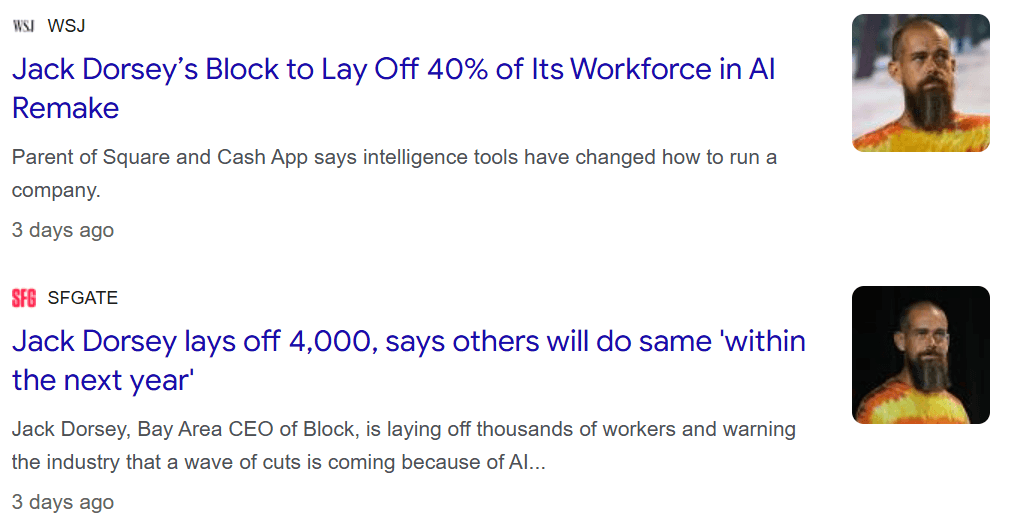
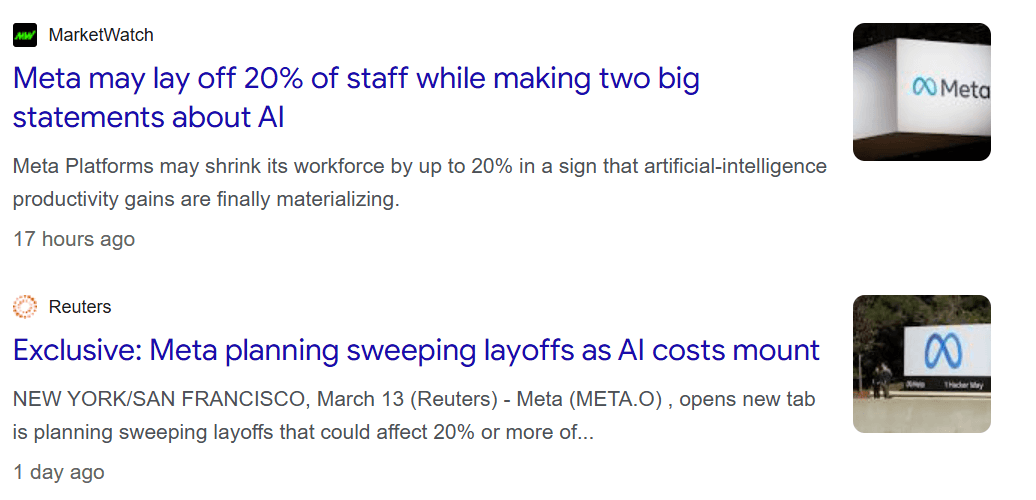
And there’s another point about pricing and markets. The report argues that simply the possibility of doing something with AI — like building internal tools instead of buying external software — can weaken the leverage vendors once had. If I can build my own Adobe, then I will definitely think twice before paying for an Adobe subscription. Now this is a small example, think what will happen to SaaS platforms like CRM tools.
A Different Way of Framing the Question
Where the report became most interesting to me was when it seemed to assume that AI would mostly be used to replace human labour. That’s a plausible path — but it’s not the only one. And it doesn’t have to be the default.
When we talk about AI, there are really two broad ways companies can use it.
One is to view it as a substitute for people. If a company adds an AI agent and, as a result, decides it doesn’t need as many analysts, designers, or managers, then yes — that reduces payroll. But if that reduction in payroll isn’t matched by growth in demand, then the system can lose momentum.
The other way is to view AI as a way of upgrading what people can do. When AI is used to augment human work, not just replace it, it changes the equation. People still have value because they’re the ones guiding the technology, shaping context, making judgment calls, and building new things that didn’t exist before.
It’s not that one of these paths is “right” and the other is “wrong.” But as leaders, we have to choose which path we are intentionally creating.
Where I See the Real Opportunity
This brings me to something I think about often: the difference between thinking of AI as a cost reduction tool and thinking of it as a capability multiplier.
The scenario in the Citrini report starts with layoffs and ends with a kind of negative spiral because it imagines AI mostly being used to cut payroll. But if organisations use AI to amplify the skills and productivity of their people, we get a very different result.
At Leadapreneur, this is not an abstract idea. It’s the reason this work exists. Its the whole reason this company was built by Jan Bartscht since the rise of Industry Revolution 4.0.
It’s not enough to teach people how to use tools. What makes a difference is teaching them how to amplify their work with these tools. How to redesign workflows. How to solve problems in new ways. How to create things that didn’t exist before. That’s what increases capability. That’s what future-proofs an organisation. Leadapreneur is here to future-proof your organisation.
When a team learns how to do more with AI, how to build and deploy projects that improve the business, innovation happens. Revenue grows. This is how the loop can change.
A Loop Worth Building
If the worry is that unfettered AI adoption could contribute to a negative economic loop, then the more important question is this: Can we build the opposite loop?
I think so.
We’ve been talking about something we call the Dare to Be Great Loop. It looks like this:
AI makes people more capable.
More capability leads to new ideas and innovation.
Innovation drives new revenue.
New revenue means investment in people.
Investment in people strengthens demand.
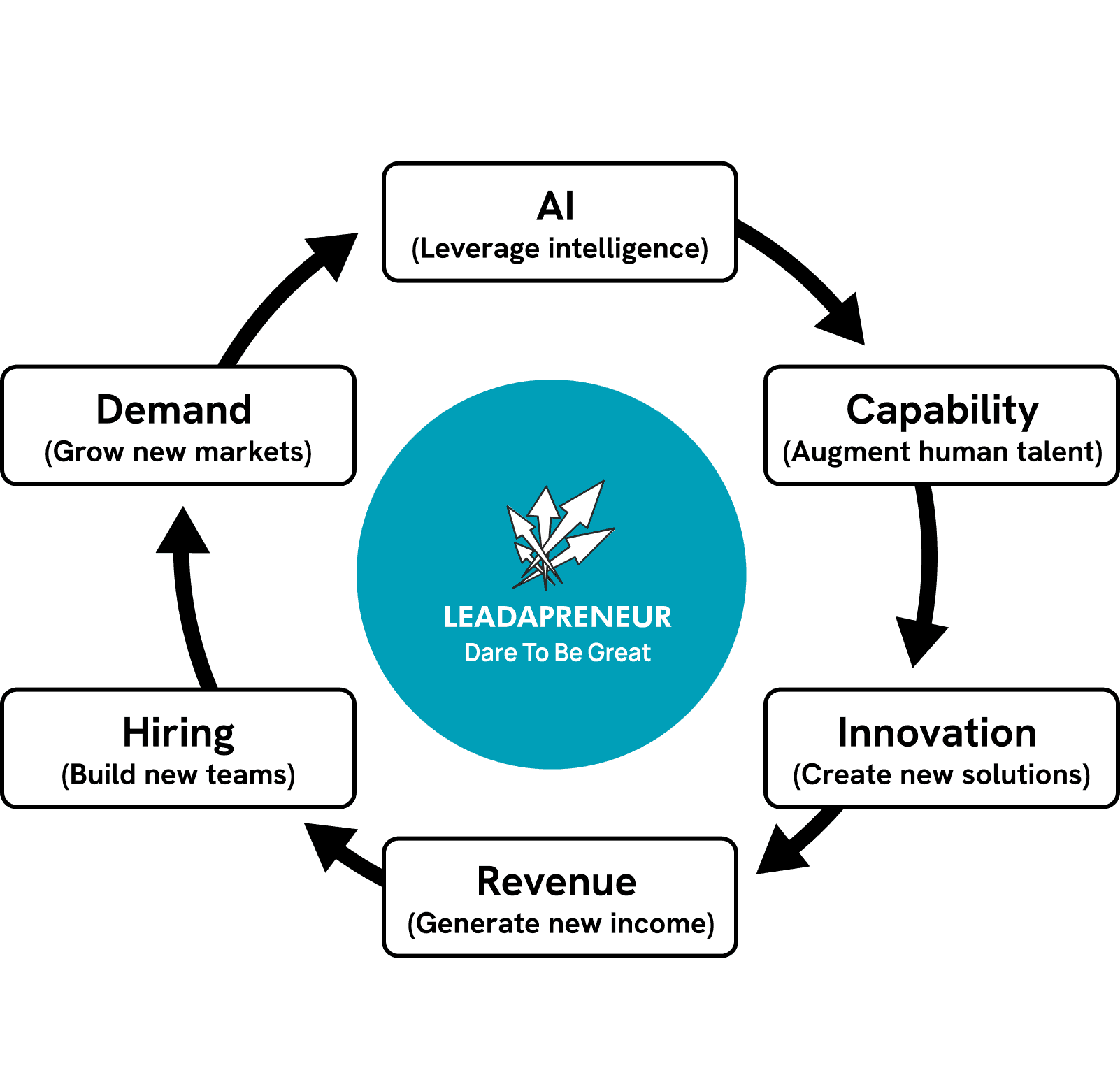
It’s still a loop, but it’s a reinforcing loop of growth and value creation.
Why This Matters
Reports like the Citrini piece are useful not because they give us a blueprint for the future. They help us ask better questions about how we want the future to unfold.
The real driver of economic outcomes isn’t the technology itself. It’s the choices people and organisations make about how they use it.
I shared this with my team recently. And what I told them felt almost more important than the analysis itself: the future doesn’t belong to machines alone. It belongs to the humans who know how to lead with those tools.
So if you’re curious about where the economy is heading, don’t ask whether AI will get smarter. Ask whether the people around you — and yourself — are learning to become smarter in different ways.
Are you using AI to improve your work, build solutions, and create value? If your answer to any of the above is no, you need an AI x Talent accelerator, and we are happy to talk to you about it.